In the wake of excitement after Obama’s inauguration, I asked students to write a letter to our new President asking him to examine the issue of gender and education with a critical eye on the ways in which feminism might be addressed in the curriculum. All of the letters, 11 total (8 by girls, 3 by boys), were fantastic. Here’s one from an African American female student that captures the urgency of teaching issues of gender and feminism in K-12 classrooms: Continue reading →
As a teacher always in search of new texts, You Tube has opened up a treasure trove of possibilities for my Queer Identities: LGBT Literature and Film course.
With my school’s requirement of homework blogs, has come the additional perk of assigning videos that allow my students to become acquainted with authors such as James Baldwin and Leslie Feinberg even before we begin reading their novels. In addition, students can also learn about gender via short educational films such as Transgender Basics by the Gender Identity Project.
The following post can also be found on the teacher group blog Equality 101.
Six years ago, my three English department colleagues and I replaced an outgoing department of two women who had left for career and life changes. Sensing an exciting opportunity for innovation, we felt that we were on the ground floor for making sweeping changes to the high school English program that could be shaped by our vision.
To design a new program, we needed a shared experience that would bring us to a generative space of thinking creatively with each other. We wanted our experience of redesigning the program to be one that had a “curriculum” of its own with writing, reading, research, and reflection. In essence, we wanted the same intellectual engagement as collaborators that eventually our students would experience and (hopefully) enjoy as learners.
“This is to Mother You” was an original single by Sinead O’Connor and was re-recorded by O’Connor, Mary J. Blige, and Martha B in the summer of 2009 especially for GEMS’s fundraising efforts to stop commercial sexual exploitation of children.
Seeing the photo of members of my feminism class–all of whom are high school juniors and seniors–holding signs in the video reading “I am a survivor” and “You will survive” emphasizes the message about where we as feminist educators can and need to do the work of awareness about sex trafficking: in our very own classrooms.
The video above as well as the film Very Young Girls can easily connect to middle/high school units and courses focusing on human rights, media literacy, gender and women’s studies, health, and the history and literature of slavery.
For those in need of a text, I suggest using GEMS founder and executive director Rachel Lloyd’s Op-Ed “Corporate Sponsored Pimping Plays Role in US Human Trafficking.” Lloyd’s excellent piece can be taught in everything from a literature or media class to a math, economics, or government course to classes on music and music production. Lloyd brilliantly analyzes how corporate dollars not only reward pimp culture but ultimately contribute to the blind acceptance of the degradation of women and girls both on our local streets and on our local screens. Lloyd states:
“It would be easy to point to hip-hop culture as the primary culprit of this tidal wave of acceptance towards pimps. Hip-hop clearly needs to take responsibility for its ongoing misogynistic images and lyrics, but rappers could not have achieved what has become a mass acceptance of pimp culture alone. The tipping point came in 2003, when 50 Cent released his platinum selling song P.I.M.P. Several months later, Reebok rewarded him with a 50 million dollar sneaker deal. A few years later, Vitamin Water did the same. Why wouldn’t they? ‘Fiddy’ proved unequivocally that no one was objecting to his blatant degradation of women and girls when P.I.M.P went platinum three times and reached the Top 10 in 18 countries.”
Too often we say that don’t have the resources to address contemporary issues within our discipline. Conducting a close reading of this passage alone with our students points to the multiple fields in which we teach: economics, history, literature, media, music, politics, women’s studies, and much more.
No matter how we address sex trafficking in our classrooms, the upshot is to teach our students to take action. Content alone is not enough.
The Council of Daughters, which is also a part of GEMS, sent a letter today to its members with President Obama’s proclamation of January 2010 as National Slavery and Human Trafficking Prevention Month. They included five things we can do to stop human trafficking:
But doing just one thing on National Human Trafficking Awareness Day or even National Slavery and Human Trafficking Prevention Month is also not enough.
Everyday must lead to the abolition of modern slavery. Start with yourself, start with your students, start with your school. Just one thing everyday.
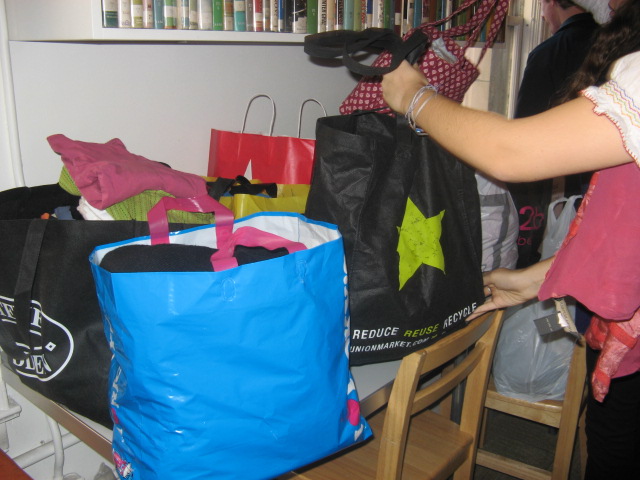
Bags upon bags of clothing and baby item donations for GEMS.
Think young people are not interested in feminist activism? Think again.
High school students in my Fierce and Fabulous: Feminist Women, Writers, Artists, and Activists class spent the better part of the fall trimester learning about and supporting efforts to end sex trafficking and commercial sexual exploitation of girls and women both here in NYC and globally.
In class, students watched the film “Very Young Girls,” made by GEMS (Girls Educational and Mentoring Services) whose mission “is to empower young women, ages 12-21, who have experienced commercial sexual exploitation and domestic trafficking, to exit the commercial sex industry and develop to their full potential. GEMS is committed to ending commercial sexual exploitation and domestic trafficking of children by changing individual lives, transforming public perception, and revolutionizing the systems and policies that impact sexually exploited youth.”
As part of the unit, outreach workers from GEMS visited the class and further explored the personal implications and horrors of domestic trafficking. Students then collaborated to present a school-wide assembly, which took place on Tuesday, November 17, 2009, to rally their high school peers to support GEMS.
The assembly included clips from “Very Young Girls,” statistics on commercial sexual exploitation of children (CSEC), speakers from GEMS, and the students’ personal response to the issue and the film. My students and I were so moved to see that within 24 hours of the assembly, an outpouring of clothing donations, including items for children and babies, came in through the school doors from students, faculty, and our principal.
I was also particularly moved when members of the Community Service Roundtable, our school’s philanthropy club that funds children’s groups in New York City, were so inspired by their peers’ presentation, that they unanimously decided to support GEMS as part of their fundraising efforts this year. Their genuine interest in supporting GEMS made me believe in the power of peer education on issues of social justice.
To continue the conversation about sex trafficking, Taina Bien-Aime, executive director from Equality Now, visited the class to talk about the issue on a global level. A later visit from Mia Herndon, executive director of the Third Wave Foundation, further exposed students to social change through feminist philanthropy and grantmaking.
Students also visited the exhibit Journey, an art installation that explores one woman’s “journey into hell” when she was trafficked to the UK. British actor Emma Thompson curated the exhibit. As we moved through the interactive exhibit, my students and I found ourselves feeling and even smelling the terror of trafficking.
This HIV/AIDS poster was created by a GEMS girl; it won first place in a contest.
At the end of the trimester, students visited the GEMS office to deliver their donations and to participate in GEMS’ weeklong observance of World AIDS Day in December. Students played educational games such as AIDS “Jeopardy” with GEMS girls. Although the course has now ended, the students and the larger school remain energized and inspired to foster a long-standing partnership with GEMS.
As a feminist educator, I am extremely proud of my students and school for taking the issue of commercial sexual exploitation of children so seriously and for moving forward with a deep commitment to social justice for young women and girls.
Rachel Maddow shares a laugh during my interview of her at my school.
“Activism is soothing to the mind.”
These exciting and inspiring words from Rachel Maddow were heard by a group of our high school students Thursday, April 23, 2009. Maddow’s incisive political commentary and analysis on her MSNBC program The Rachel Maddow Show has won her the admiration of progressive news viewers, pundits, academics, and activists, including our very own high school students and faculty.
Gathered in our library’s intimate and sun-filled study space, Maddow and fifty students and teachers talked about her career as well as her views on current political events and issues. Of course, I’ll never forget our shared moment of singing and seat dancing to the Schoolhouse Rock jingle “I’m Just a Bill” for the gleeful benefit of students who hadn’t grown up in the 70’s.
Citing her own trajectory as a political science major at Stanford and then as an Oxford Rhodes Scholar writing her dissertation on HIV/AIDS, Maddow encouraged students to major in liberal arts fields such as literature, philosophy, history, and political science rather than communications or journalism. As a die-hard English teacher, I was particularly thrilled when Maddow urged students to “write, write, write.”
Responding to a female student’s question, “What advice would you give to young women interested in journalism?” Maddow gave this outstanding answer: “Get really good at arguing, make solid arguments and use really good evidence, not conjecture.”
Rachel Maddow on activism: "The fight in your life will find you."
To all students seeking a life in activism, Maddow said, “The fight in your life will find you.”
At the end of my interview, I presented Maddow with the children’s book And Tango Makes Three by Justin Richardson and Peter Parnell, citing that on a recent episode of Maddow’s show, Maddow and Kent Jones had just marked the third anniversary of the book on the banned books list. And Tango Makes Three sits proudly on the read-aloud lists of our lower school colleagues at my k-12 school. The look on Maddow’s face when I opened the book to show her our students’ signatures was priceless (see photo slideshow below). I also presented Maddow with a signed copy of Staceyann Chin’s new memoir The Other Side of Paradise.
The energy and excitement of the event was made all the more amazing when students and faculty reached out to me with thanks for organizing Maddow’s visit. One student’s email said it all: “Meeting Rachel Maddow made my whole year, I’m now inspired to be an activist and journalist.”
Open to all students in the high school, the event attracted those who have taken my colleagues’ courses on constitutional law, journalism, banned books, the global war on terror, economics, human rights, and my courses on feminism and LGBT literature and film.
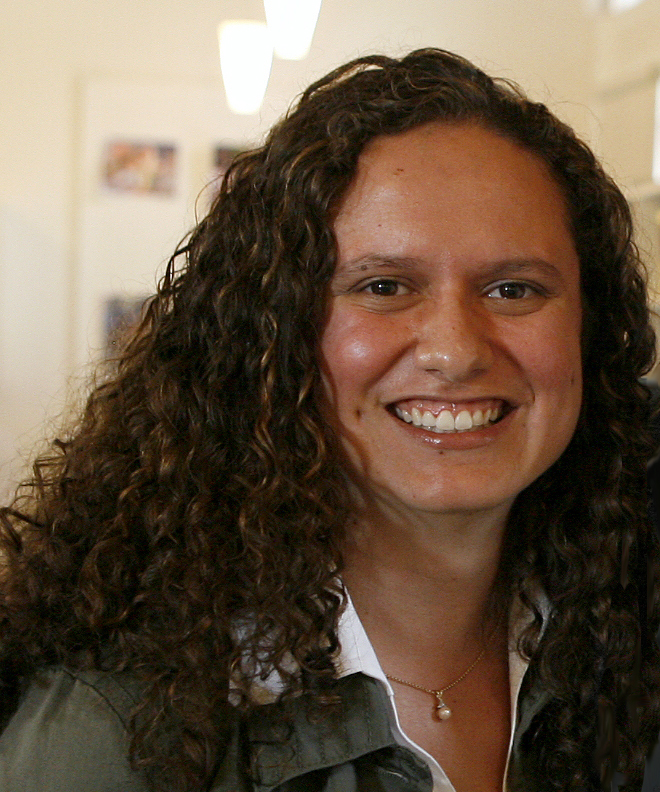
Welcome to my Feminist Teacher blog, a site of inquiry for those interested in equity and justice in today’s classrooms. I am Ileana Jiménez, a thirteen-year veteran of both single sex and progressive independent schools, and I am excited to engage in this conversation with you.
Too often, academic conversations about feminism, women’s studies, gender studies, queer or LGBT studies, as well as studies such as African American, Asian American, Latino/a, Middle Eastern, and Native American studies, focus largely on higher education classrooms and the professors and scholars who teach and conduct research in these fields, leaving out teachers in secondary, middle, and early childhood education who also teach and conduct research on these subjects.
The invisibility of teachers in discussions of feminist pedagogy removes us from being seen as significant contributors to a variety of academic fields, and equally as important, from being recognized as providing young people and children with curricular experiences that are rich and meaningful.
But we are out there for sure. We are doing the work of feminist scholarship and we are doing the work of feminist curriculum and even feminist activism with our students.
This blog intends to expand the circle of discussion to educators in the k-12 sector who consider their teaching practices to be feminist in design and implementation. My goal is to make us visible to each other and to the larger world of educators, as we move forward with our important work. For this reason, I hope it will be a place of community and conversation, both inspiring and invigorating.
In my mind, a feminist pedagogy is one in which issues of race, class, gender, sexuality, ethnicity, religion, age, ability, politics, and human rights—among others—inform a teacher’s philosophical vision that shapes not only content but also action, both that of the teacher as well as the students in the classroom and beyond.
Let this site also be a place of action: the action of the mind and of the heart for greater gender, racial, and economic justice.


 Feminist Teacher