Teaching Rachel Lloyd’s Girls Like Us on the Commercial Sexual Exploitation of Children

My student, Genevieve, interviews Rachel Lloyd, founder and director of GEMS, about her memoir Girls Like Us at our 2011 annual  GEMS assembly (photo courtesy, Laura Hahn).

My student, Genevieve, interviews Rachel Lloyd, founder and director of GEMS, about her memoir Girls Like Us at our annual GEMS assembly in 2011 (photo courtesy, Laura Hahn).

In the spring of 2009, I was searching for something to make my then new high school feminism course have a sense of purpose. I wanted to teach students not just feminist theory and literature but how to learn and care strongly about an issue to mobilize them into action and advocacy.

My students wanted more out of the course, too. One after another, they–both girls and guys–shared in their course evaluations that they wanted to learn about a current issue involving girls and women that they could rally around. I took their request seriously.

That spring, I chanced upon a screening of Very Young Girls (2008) at Bluestockings, a radical feminist bookstore on the Lower East Side of New York. The film documents the work that Rachel Lloyd, founder and chief executive officer of GEMS (Girls Educational and Mentoring Services), has done to stop the cycle of commercial sexual exploitation of children in New York’s streets. Founded in 1998 in Lloyd’s own kitchen, GEMS is the only agency in New York State specifically designed to serve girls and young women who have experienced commercial sexual exploitation and domestic trafficking.

Among many services that provide prevention and outreach, GEMS ultimately helps girls and young women leave their exploiters–or their pimps–to live new lives of survival and support and eventually, of leadership and vision.

After attending that one screening, my entire course changed. Continue reading
High School Feminism Students Address School Sexual Harassment at UN Commission on Status of Women

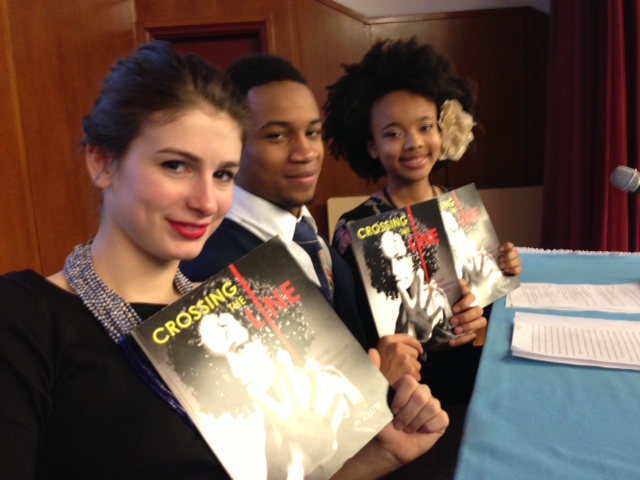
My high school feminism students, Josey Stuart and Noel Diggs, (front) and Emily Morenike Carpenter from Girls for Gender Equity spoke on a panel addressing the findings in the AAUW report, Crossing the Line: Sexual Harassment at School. (photo credit: Ileana Jiménez).


This year’s 57th session of the UN Commission on the Status of Women taking place currently in New York from March 4-15 is focusing on the elimination and prevention of all forms of violence against women and girls with a particular focus on the equal sharing of responsibilities between women and men.

As part of a series of UN parallel events taking place in various venues was a panel sponsored by the AAUW (American Association of University Women) highlighting the findings of their important study Crossing the Line: Sexual Harassment at School. As Crossing the Line co-author Holly Kearl noted: “The AAUW was one of the first organizations to talk about sexual harassment in schools in 1993, and they continue to be a leading voice on the topic.”

Holly invited my high school feminism class students Josey Stuart and Noel Diggs to sit on the panel along with Emily Morenike Carpenter from Girls for Gender Equity; all students shared their insights on how to address sexual harassment in schools.

Josey mentioned that “to learn, you need to be in a safe environment, you need to feel like you’re able to express yourself, you can’t be focused on the constant fear of being harassed,” while Noel highlighted the importance of teaching students to shift their language away from misogynist messages such as “bagging” girls sexually and using words such as “gay” in negative contexts.

Emily noted that “instead of having faculty talk down to students and saying ‘this is what sexual harassment is,’ we can have students define and talk about sexual harassment in a way that gives them agency and supports their voice.”

Holly highlighted that “48% of students experienced sexual harassment during the 2010-11 school year, including more girls than boys, especially in the upper grades. 30% experienced cyber-harassment and most of them were also harassed in person. Nearly one in three students witnessed harassment happening, including more girls than boys.”

During my portion of the panel I highlighted: Continue reading